The Boozer’s Rosetta Stone: A Field Method for Britain’s Painted Pub Signs
Britain has a way of turning a simple question — what’s that pub called? — into a ten-minute seminar on heraldry, local history and the dangers of repainting a swan. The Swan With Two Necks is the classic trap. It sounds like a creature from a very specific nightmare, but the name probably has less to do with mutation and more to do with ownership marks: a swan with two nicks on its bill, recorded by the Vintners’ Company. Say ‘two nicks’ often enough, add a signwriter with a confident brush and a shaky grasp of ornithology, and you get two necks.
That is the joy of the British pub sign. It is not really signage. It is a small, hanging document, often repainted, frequently misunderstood and occasionally held together by hope and a rusty bracket. As of 2026, these boards remain one of the country’s most quietly eccentric offline curiosities: free to look at, hard to decode and usually best admired from the pavement rather than halfway up a ladder.
First, Learn the Sign’s Grammar
A pub sign rarely says what it means in plain English. It works more like a dialect. There are heraldic signs, where lions, stags and griffins are doing family-tree admin. There are trade signs, where hammers, anvils, coils and carts advertise industries that may have left town decades ago. There are royal signs, often updated with the enthusiasm of a school history project. There are puns, some of which have aged like milk. And then there are the true mysteries: names that seem to have been assembled by committee during a power cut.
When a sign makes no sense, resist the urge to invent a romantic legend immediately. Try the boring explanations first. A word may have been misheard. A local surname may have been absorbed. A trade may have vanished. A heraldic animal may have been copied badly from an older board. The sign is not necessarily lying; it may simply be repeating a very old mistake with fresh paint.
The Swan With Two Necks is a useful first lesson because it shows how a sign can survive its own explanation. The creature is probably a clerical error with a long lease. The pub keeps the name because the name is now the point. A corrected swan would be historically tidier and considerably less fun.
The Two-Neck Test: What to Do When Nothing Adds Up
Stand outside a puzzling pub and run through a short checklist. Does the name involve an animal doing something impossible? Assume heraldry, a badge or a butchered motto. Does it involve a tool, a vessel or a material? Assume a lost trade. Does it sound like a phrase that has been put through a local accent and then written down by someone in a hurry? Assume mishearing. Does it mention a person, a battle, a family or a strange object with no obvious pub connection? Assume local pride, a long lease and a landlord who is tired of explaining it.
This is not an exact science. Pub signs are not railway timetables. They are closer to folk art with a licence to sell crisps. The pleasure is in the looking, not the final answer. A good sign gives you something to argue about while the kettle boils.
A Board Is Also a Document
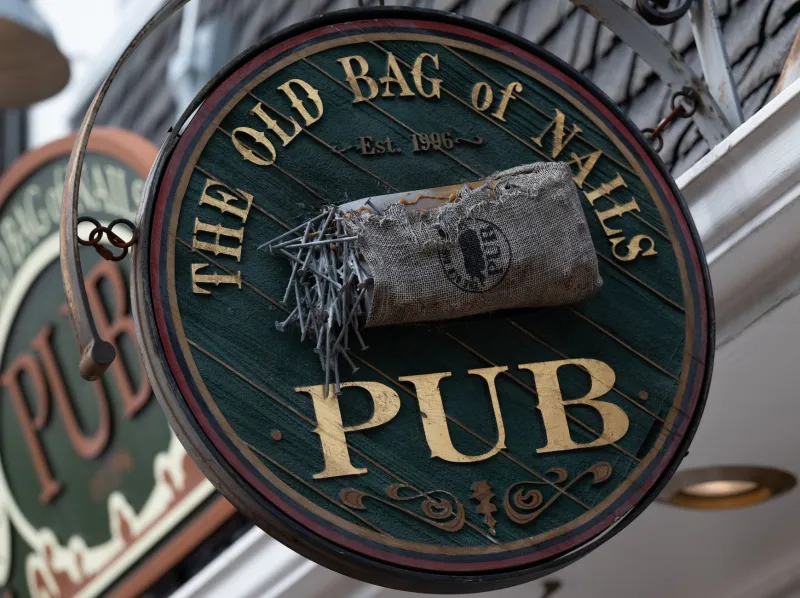
Look at the sign itself, not just the name. Is it painted or printed? Is the lettering hand-done, with the tiny wobbles that suggest a human being rather than a software template? Has the pub’s name been altered, or has the picture been repainted around an older shape? Are there layers? A sign that has been touched up repeatedly is a bit like a village noticeboard: the current message is only the top layer.
Materials tell tales too. A traditional hanging board on an iron bracket feels like it has been there since coaching days, even if it was actually installed in 2019 by a landlord with strong opinions about heritage. A flat sign fixed to the wall may be older, newer or simply the result of a planning compromise. None of this is glamorous, but it is exactly the sort of offline curiosity worth noticing: the small, public object that has quietly accumulated a century of decisions.
When the Industry Leaves, the Name Stays
Some of the best pub names are fossils. They commemorate trades that no longer employ anyone in the area, routes that no longer carry coaches and industries that have been replaced by a retail park and a polite information board. The name stays because changing it would upset the regulars and confuse the taxi driver.
This is where pub signs become genuinely useful to the idle historian. They show what a town once thought was important. A sign celebrating a forge, a mill, a market or a river crossing is not just decoration. It is a tiny public memory, often inaccurate, always local. The fact that it is attached to a building selling salted snacks does not make it less interesting. If anything, it makes it more British.
Field Etiquette for the Sign Spotter
You do not need a clipboard to enjoy this. A phone camera and a bit of restraint will do. Photograph from the pavement rather than the middle of the road. Do not block the door, lean on someone’s planters or stand under the sign like a surveyor while a delivery van waits. If the landlord is outside, ask about the name. Most will either know the story or have a better one ready.
And if you are tempted to correct a sign’s spelling, history or swan anatomy, remember that the pub has probably heard it before. The board is not an exam question. It is a hanging piece of local stubbornness, painted by hand, fixed to a wall and left to confuse strangers. Long may it remain so.
The Payoff
A pub sign is a free exhibition with a built-in pub at the end. It rewards slow looking: the odd spelling, the overconfident lion, the swan with too many necks and the name that has outlived every sensible explanation. In a country that loves an unofficial museum, these boards are among the best small exhibits we have. Just do not ask the swan to explain itself. It has been through enough.