Geraniums of State: A Field Decoder for Britain’s Roundabout Bloom
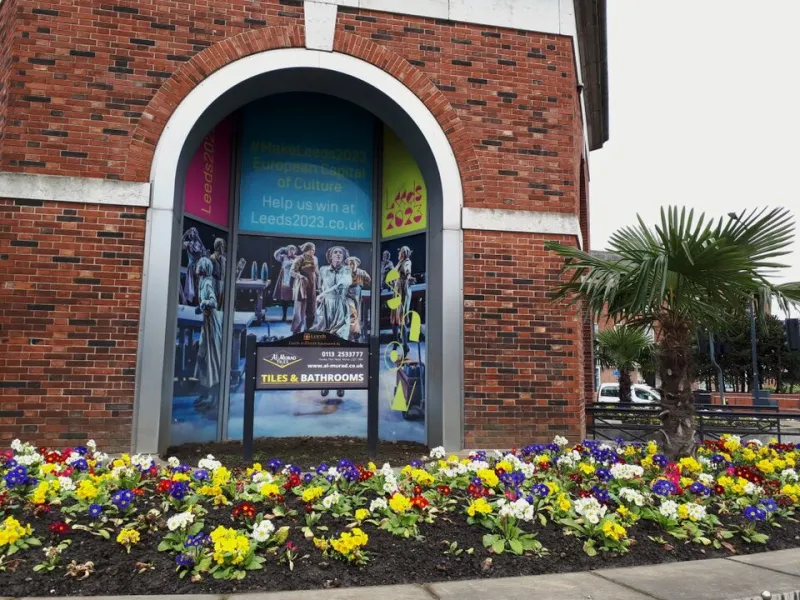
Photo: Stephen Craven , CC BY-SA 2.0, via Wikimedia Commons
There is a particular kind of British flower bed that nobody puts on a postcard and everybody drives past. It sits on a roundabout, or beside a leisure centre, or under a sign that says Welcome to Our Town in letters slightly too small to read at 30mph. It is planted with military precision, watered by rota, and it is trying to tell you something. Not about botany. About civic self-esteem.
This is the municipal flower bed: part horticulture, part press release, part quiet threat to the neighbouring council. And once you start reading them, the summer drive to the garden centre becomes a tour of local government body language.
The Roundabout as Press Release
A roundabout bed is the cheapest billboard a council owns. No planning permission, no advertising revenue, no letters to the editor about eyesores — just a ring of bedding plants saying we are still here and we still care about hanging baskets. The classic format is carpet bedding: low-growing plants packed tight into a geometric pattern, often a clock, sometimes a crest, occasionally something that looks like a municipal logo after a difficult night.
The craft is genuinely old. Victorian and Edwardian parks departments turned bedding out into a competitive art form, and the tradition never quite died — it just moved to the ring road. Today the palette is usually geraniums, petunias, begonias, marigolds and a few faithful pansies, arranged in colours that would make a wedding planner wince and a councillor proud. The point is not subtlety. The point is visibility from a moving vehicle, which is why so many displays look like they were designed by someone shouting.
Reading the Crest in Geraniums
Look closer at the pattern. A floral clock is a statement of civic ambition: we have a parks department, a budget line and someone who can read a planting plan. A council crest picked out in red and yellow bedding is a statement of continuity: we have been here since 1974, and we would like you to know it. And a big colourful number — an anniversary, a millennium, a twinning — is a statement of event-led funding: someone found a grant and spent it on begonias before anyone could ask about the pavements.
The quiet one-upmanship is real. Towns compare. Resorts compare harder. A seafront border that runs for half a mile is not just a flower bed; it is a municipal peacock display aimed at the next town along the coast. Britain in Bloom has a lot to answer for, and most of it is wearing a tabard and holding a clipboard.
The Budget Cut Reader
Here is where the field guide gets useful. A flower bed is a financial document you can smell. When the bedding gets thinner, when the geometric pattern becomes a vague swirl, when the petunias are replaced by a robust perennial that looks like it was rescued from a skip — that is not a design choice. That is a budget meeting.
The giveaway phrases are everywhere once you notice them. Wildflower meadow can mean a genuine biodiversity scheme. It can also mean we stopped bedding out and let the weeds unionise. Pollinator-friendly planting is often excellent ecology. It is also occasionally austerity with a press release and a picture of a bee. And the municipal mulch mountain — that dark brown dome beside the car park — is the universal symbol of a parks department doing its best with what is left after the hanging baskets have been paid for.
The Wilting Welcome
The most poignant specimen is the welcome sign bed. You know the one: Welcome to Our Town, twinning plaque, maybe a small bench, and a rectangle of soil in which three pansies are having a difficult time. In June it looks hopeful. By late August it looks like a metaphor for local democracy. The sign says welcome; the deadheads say we ran out of staff in week three.
This is not cruelty. It is realism. Municipal bedding is a seasonal contract with the weather, and the weather does not read the maintenance schedule. The trick is to read the bed at the right moment — early summer, when the council is still pretending it has a plan, or late summer, when the honesty sets in.
Field Notes: How to Audit a Bed
A practical checklist for the pavement horticulturalist:
- Count the colours. More than five suggests a grant. Fewer than three suggests a spreadsheet.
- Check the symmetry. Perfect symmetry means a parks department. Near-symmetry means a contractor. No symmetry means a volunteer with a tray of leftovers.
- Look for the crest. A floral crest is civic confidence. A floral logo is rebranding. A floral question mark is somebody’s art project.
- Note the weed ratio. One dandelion is charming. Twenty is a staffing issue.
- Look for additions. A beer can, a gnome, a laminated note, a single optimistic sunflower. These are the guerrilla footnotes of the British street.
What the Bed Is Really Saying
Britain’s municipal flower beds are ridiculous, and that is why they are lovely. They are planted by people who know the display will be seen for four seconds from a Vauxhall Corsa, and they do it anyway. They are a small, stubborn act of civic presentation in a country that otherwise communicates through potholes and bin day leaflets.
So next time you slow for a roundabout, ignore the satnav and read the bedding. It might be saying welcome. It might be saying we have a budget. It might be saying the neighbouring town has a bigger floral clock and we are not over it. Either way, it is local pride in petals — and it is worth a second look.