Pressed Glass and Paperbacks: A Very British Guide to the Village Phone Box Library
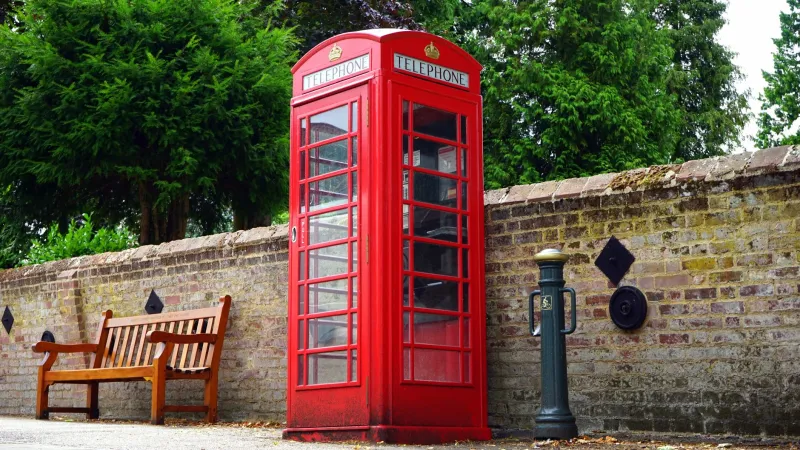
There is a particular kind of British optimism that looks at a decommissioned red telephone box and thinks: what this needs is a laminated sign and a copy of The Thursday Murder Club. Not a monument, not a museum piece, not a planter for aggressive geraniums — a tiny, glass-sided library. Or a seed swap. Or a miniature museum of local drainage history. Or, increasingly, a defibrillator with a paperback taped to the door.
This is the phone box library, and it is one of the country’s most quietly delightful offline institutions. You will find them in villages with one pub, two notices about a missing cat, and a bus service that exists mostly as a rumour. They are free, they are open at odd hours, and they ask almost nothing of you except that you close the door and do not treat the whole thing like a skip with windows.
The K6 Has Had a Career Change
Most of the boxes doing this work are K6s — the classic red design from the 1930s, all domed roof and small panes of glass. For decades they were places to shout “I’M ON THE TRAIN” at a patient aunt. Then the mobile phone happened, the queues vanished, and many were removed or left to rust. Some were adopted by communities under BT’s Adopt a Kiosk scheme, which is a very British sentence: a telecoms company offering you a redundant piece of street furniture, and a parish council saying, “Yes, we’ll have that, we’ve got plans.”
The plans are rarely grand. They are usually: books. Perhaps seeds. Maybe a small display about the village well. One box might be a book exchange; another might hold a jigsaw with 37 pieces missing and a note saying “PLEASE DO NOT ADD PIECES FROM HOME.” The phone box has become a village noticeboard with a roof, and somehow that is exactly what it needed to be.
The Etiquette Is Mostly Unspoken, Which Is the Problem
The rules of a phone box library are not written down in any formal way, which means they are enforced by raised eyebrows and passive-aggressive notes. The core principle is simple: take a book, leave a book, or at least leave the place as you found it. This is not a charity shop. You are not donating forty copies of a diet book from 2004. You are participating in a small, fragile ecosystem.
Useful etiquette, in no particular order: do not cram the shelves until the door won’t shut; do not leave damp books, because the box is effectively a greenhouse for mildew; do not use it as a bin for old Yellow Pages; do not rearrange the entire collection alphabetically unless you are the appointed curator, in which case, carry on. And if you open the door and find a defibrillator, do not leave a Dan Brown in the little cabinet. That is not a library. That is a piece of life-saving equipment with a very confusing exterior.
A Cornucopia of Slightly Damp Paperbacks
The contents are where things get gloriously odd. You will find the expected: crime thrillers, family sagas, cookbooks with pages stuck together by ancient gravy, and at least one copy of a book about a boy and a dog that makes everyone cry. You will also find the unexpected: seed packets with handwritten labels, local walk maps, poetry pamphlets, a mini museum of old tools, a jar of jam with an honesty box, or a display about a village that once won a best-kept-verge competition.
One box might be a book exchange; another might be a seed swap with a sign saying “PLEASE TAKE ONLY WHAT YOU WILL PLANT.” Another might contain a jigsaw, a note about the church roof fund, and a single devotional candle. The phone box library is not a curated space. It is a small, glass-fronted expression of local personality, and that is why it is worth visiting.
Finding One Without Becoming a Menace
Start by looking for signs: “community library,” “book exchange,” “seed swap,” or a laminated A4 sheet with too many exclamation marks. Parish council websites often mention them, as do local Facebook groups, though that requires going online to plan an offline curiosity, which is a bit like reading a cookbook on a treadmill. Ask in the village shop. Ask the person walking a dog. Ask anyone who looks like they have strong opinions about hanging baskets.
When you find one, behave. Do not photograph strangers without asking. Do not block the pavement with a tripod. Do not treat the box as a tourist attraction while a local is trying to swap a Catherine Cookson. Take a book, leave a book, close the door firmly, and resist the urge to reorganise the shelves unless you have been explicitly invited. The vibe is delicate. It is held together by goodwill, laminating pouches, and the unspoken belief that people will generally not be weird about it.
The Characters Behind the Glass
Every phone box library has a keeper, even if nobody calls them that. It might be a retired teacher who restocks the crime section, a vicar who quietly removes the more alarming conspiracy pamphlets, or a neighbour who wipes the glass and replaces the damp copy of Captain Corelli’s Mandolin with something less soggy. They are not librarians in the formal sense. They are curators of a very small, very local collection, and they deserve a quiet nod of respect.
The Small Pleasure of a Tiny Institution
The phone box library is not efficient. It is not always well stocked. It is occasionally full of wasps and invariably smells faintly of old paper and wet coats. But it is free, it is open, and it belongs to everyone and no one. In a world of algorithms and accounts, there is something deeply satisfying about walking to a red box at the end of a lane and finding a paperback someone else thought you might like. Take one. Leave one. Close the door. And whatever you do, don’t leave the Dan Brown near the defibrillator.