The Gate That Won’t Kiss You Back: Britain’s Footpath Furniture, Decoded
There is a particular kind of British optimism that begins with a muddy gate and ends with the phrase “it’s only another field.” It is the optimism of the public footpath: a legal right of way that often looks less like a right and more like a suggestion, especially after rain. But follow any path long enough and you’ll meet its furniture — not the benches and bins of the civic world, but kissing gates, stiles, waymarks, padlocked oddities and improvised repairs held together by hope and twine.
These are the orphaned fittings of the countryside. Nobody thanks them. Nobody photographs them for calendars. Yet each one tells you something about the place: who maintains it, who resents it, who paints its arrows, and who last tried to get a small dog through a gap designed for a medium-sized sheep.
First, a word about the kissing gate
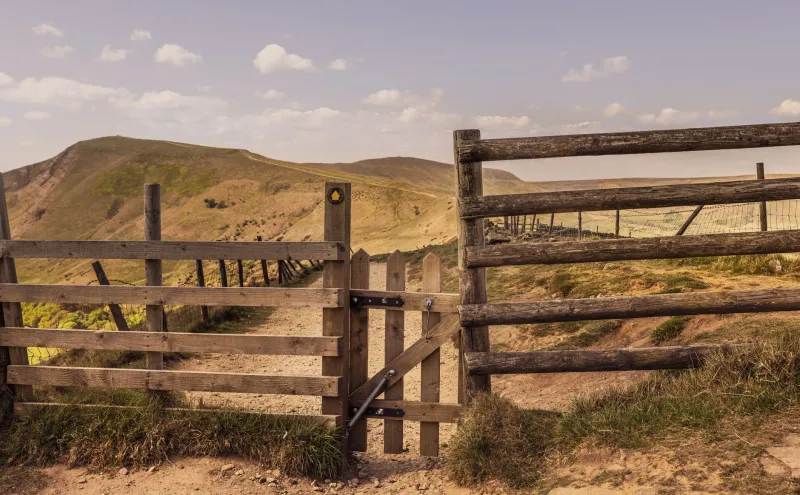
The kissing gate is Britain’s most socially awkward piece of infrastructure. It swings within a small enclosure, allowing one person through at a time while theoretically preventing livestock from escaping. The name sounds romantic. The reality involves manoeuvring a rucksack, a waterproof map case and a thermos through a metal elbow while a stranger waits on the other side pretending not to watch.
A good kissing gate is well oiled and swings with a polite clunk. A bad one has a hinge that shrieks like a haunted kettle and a latch that requires the strength of a farmer and the patience of a saint. Some are wooden, some galvanised, some so freshly painted you leave with a stripe on your thigh. If you see a kissing gate with a small handwritten note attached, read it. It is usually either an apology from the parish council or a warning about a bull with strong opinions.
The stile hierarchy of needs
Stiles are the older, more stubborn relatives of the kissing gate. They come in many forms: the step stile, the squeeze stile, the ladder stile, the stone slab stile that seems purpose-built to humble a middle-aged knee. A stile is essentially a question — can you get over this without dropping your sandwich? — and the answer varies by county.
Some are beautifully maintained. Others list gently to the left as if considering a career change. A stile with a wobbly top step is a local landmark; a stile with a handy stone placed beside it is a small act of neighbourly kindness. And a stile with a gap underneath is not a design feature. It is a message from the local wildlife, possibly consisting entirely of badgers.
Waymarks: parish pride in acrylic
The humble waymark is where the British countryside reveals its inner stationery cupboard. A footpath marker may be a neat disc nailed to a post, a faded arrow painted on a gate, or a small yellow splodge that could be a waymark or could be a warning from a previous rambler. Some parishes take obvious pride in their signage. The arrows are crisp, the posts upright, the little acorn symbol clear enough to follow without squinting.
Other places seem to treat waymarks as a cryptic art form. You will find an arrow pointing confidently at a hedge, another pointing back the way you came, and a third that has been absorbed by a tree trunk over the past two decades. This is not necessarily incompetence. It may be history, budget, or a long-running disagreement about who exactly is responsible for the post at the corner of the field.
Repairs, grudges and the genius of baler twine
Nothing says rural improvisation like a gate repair involving baler twine. A proper fix would require a hinge, a screw and a trip to the agricultural merchant. A British fix often requires a length of orange twine, a knot with no known name and a quiet determination to get through the next lambing season.
Read these repairs as clues. A gate wired shut suggests livestock nearby. A stile with a new plank suggests a landowner trying to be reasonable. A padlock on a gate that should be open is practically a short story about a boundary dispute. And a sign saying “PLEASE CLOSE THE GATE” in three different handwritings suggests a parish that has tried diplomacy, repetition and eventually capital letters.
The unofficial signage network
Some of the best footpath information is not official at all. It is the laminated notice flapping inside a plastic wallet, the handwritten arrow on a piece of cardboard, the little cairn of stones beside a boggy patch. Ramblers leave marks for each other: a branch laid across a false trail, a ribbon tied to a gate, a scrawled “NOT THIS WAY” that has saved countless pairs of boots.
These unofficial signs are the offline social media of the countryside. They are local, temporary and deeply useful. They also have a lovely sense of humour. One note seen recently read “PATH FINE. BOOTS NOT.” Another simply said “MUD.” It was accurate.
How to read a footpath like a local
Next time you’re out walking, treat the path furniture as evidence. Is the gate well hung? The parish cares. Is the stile half-rotten but propped with a stone? Someone is trying. Is the waymark painted in a colour not found on any official map? You may have stumbled into a local system understood only by dog walkers and people who know which farm sells eggs at the end of the lane.
Britain’s footpaths are not just routes from A to B. They are tiny civic theatres, full of maintenance, memory and mild confusion. The kissing gate may not kiss you back, and the stile may test your dignity, but together they form a peculiar national collection: outdoor furniture with no indoor purpose, arranged across fields for our slow and muddy delight.