Two Cable Ties and an Apology: Reading Britain's Homemade Road-Closed Signs
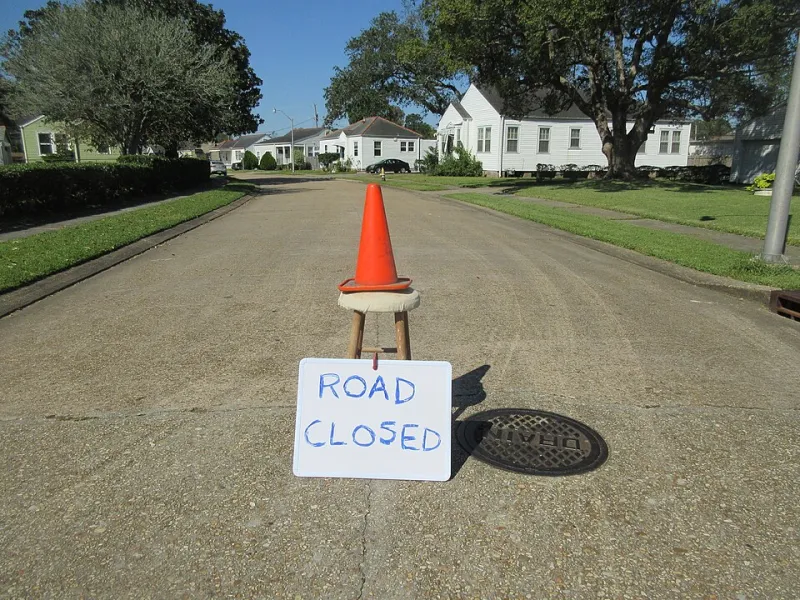
Photo: Infrogmation of New Orleans, CC BY-SA 4.0, via Wikimedia Commons
There is a genre of British literature that lives for four days, gets rained on, and then disappears into a wheelie bin. It is the handwritten road-closed sign: a sheet of A4, a biro, a laminator if the parish is feeling flush, and two cable ties holding the whole enterprise to a traffic cone.
You have seen them. You may have obeyed one. You have certainly ignored one. And like any good folk art, they repay a closer look.
The Anatomy of the Notice
The classic notice is assembled from a kit of parts. The paper is rarely new — it is the back of a photocopied hymn sheet, a letter from the council, or something with a faint map of a car boot sale on the reverse. The pen is a biro that has been in a kitchen drawer since the last jubilee. The fixing method is cable ties, gaffer tape, or, in a pinch, a single hopeful clothes peg.
The mounting is where civic improvisation truly blooms. A traffic cone is the aspirational choice. A wheelie bin is the workhorse. A hedge is the traditionalist's option. And the truly committed will thread the sign through a gate latch, meaning that anyone who wants to read it must first perform a small act of trespass.
A Taxonomy of Apologies
Every notice contains an apology, and every apology has a personality. Broadly, they fall into four camps.
The Martyr's Apology. Long, heartfelt, and slightly aggrieved. "We are sorry for any inconvenience caused during these essential works." The word essential is doing a lot of heavy lifting here, usually attached to something that looks suspiciously like a bloke with a digger and a flask.
The Terse Civic Statement. Two words, a date, and a full stop. "ROAD CLOSED." No apology. No detour. No explanation. This is the notice of a parish clerk who has been doing the job since 1998 and has stopped pretending to enjoy it.
The Overexplainer. A dense paragraph in increasingly small handwriting, explaining that the closure is due to a collapsed drain, that the contractor was meant to arrive on Tuesday, that Tuesday became Thursday, and that the whole thing is now in the hands of a man called Kevin who is "looking into it."
The Bribed Apology. My favourite. The sign that says "Sorry — cake sale in the village hall, 10am!" as if the closure is not an inconvenience but a marketing opportunity. This is peak parish optimism: the road may be gone, but the sponge cake is fresh.
The Arrow Problem
No study of the temporary sign is complete without the arrow. Arrows are where the British road notice becomes abstract art.
There is the Confident Arrow: a thick biro stroke pointing firmly left. Reliable. Reassuring. Almost certainly wrong.
There is the Negotiated Arrow: a thinner line that starts left, wobbles, and ends up pointing vaguely at a hedge. This arrow was drawn by someone who was not entirely sure of the route but felt that direction was better than nothing.
There is the Palimpsest Arrow: three arrows on top of each other, each in a different pen, suggesting a local debate that has been going on for some time and has not yet reached consensus.
And then there is the Arrow to Nowhere: a single, elegant line pointing down a lane that ends in a farm gate, a muddy puddle, and the faint sound of a tractor. Follow it at your peril. The locals know.
Excuses, Ranked by Plausibility
The reason given for the closure is often the most creative part of the document. A rough ranking:
- Water main. Plausible. Water companies are always doing something.
- Resurfacing. Also plausible, though the road in question has looked suspiciously fine for years.
- Hedge cutting. A seasonal classic, usually accompanied by a note about "visibility."
- Gas works. Serious enough to be believed, vague enough to explain the delay.
- "Tree." Just the one word. No further detail. Is the tree falling? Has it fallen? Is it being negotiated with? We may never know.
- "Vicar's car." Rare, but not unheard of. Usually a joke, occasionally not.
- "Event." The most ominous entry in the canon. What event? Whose event? The sign does not say, and the village is not telling.
Parish Optimism and the Civic Improvisation
What all these notices share is a quiet, deeply British faith that things can be sorted out locally, with what is to hand. The council has sent a generic closure order; the parish has responded with a laminator and a sense of duty. The result is not polished, but it is communication, and that is more than many official signs manage.
There is also a certain honesty to them. A printed sign says "DIVERSION ROUTE." A handwritten sign says "sorry, love, the road's gone, try the lane past the pub." One is a traffic instruction. The other is a neighbourly tip.
In 2026, when so much of our navigation is barked at us by a phone, there is something oddly cheering about a sign that was clearly made by a human being who ran out of room and had to write cake smaller than they intended.
Field Tips for the Curious Diversionist
If you find one of these notices in the wild, treat it with respect. It is doing an unpaid job.
- Read the whole thing, including the reverse. You may learn about a jumble sale.
- Photograph it before Thursday. They rarely survive the weekend.
- Note the fixing method. Cable ties suggest competence; tape suggests urgency; a clothes peg suggests the involvement of a person who owns a clothes peg in 2026, which is its own kind of curiosity.
- And if the arrow points at a hedge, trust the locals. They have seen this before.
The handwritten road-closed sign will never make it into a design museum. But as a record of how Britain apologises, improvises, and points vaguely at things, it is hard to beat. Bring a flask. Mind the hedge.