The Anonymous Yarn Parliament: Decoding Britain’s Postbox Toppers
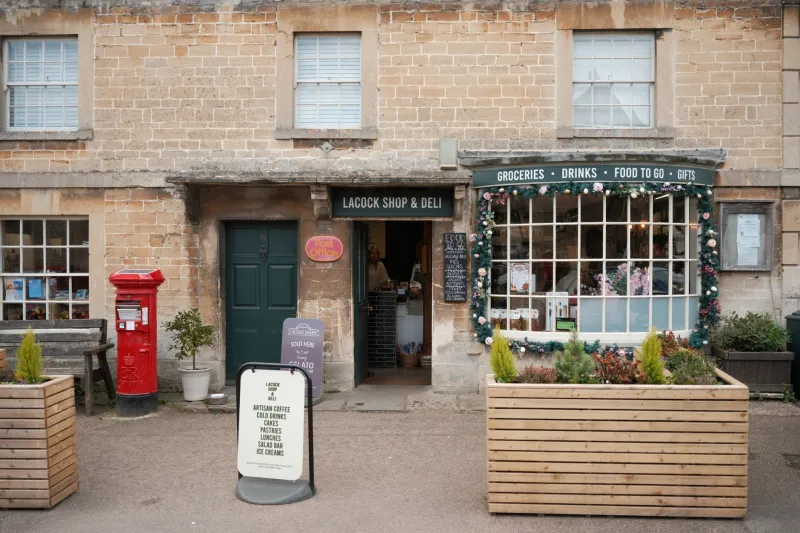
Somewhere between the parish council and the weather, Britain operates a second system of local government. It has no minutes, no chairman and no budget for stationery. It communicates entirely in double crochet. I refer, of course, to the postbox topper: the woolly hat, miniature scene or small theatrical installation that appears on top of a Royal Mail pillar box as if the postbox has quietly joined a craft club.
You have seen them. A red pillar box wearing a poppy wreath in November. A pumpkin in October. A knitted postman, a tiny bus, a dinosaur in a bobble hat. They are easy to dismiss as cute. They are actually a form of civic communication: part seasonal bulletin, part public art, part village rivalry conducted in yarn.
A Very Public Kind of Secret
The joy of the postbox topper is that nobody officially owns it. There is no plaque, no artist statement, no QR code leading to a funding application. One morning the postbox is bare; the next it has a woollen vegetable patch on its head. By lunchtime, someone has photographed it. By teatime, it is on a local Facebook group with the caption: Has anyone else seen this? Yes. Everyone has. That is the point.
Toppers tend to fall into recognisable genres. The seasonal standard: poppies, Remembrance, Christmas, Easter, harvest. The local landmark: a knitted church tower, a pier, a lighthouse, a bus that probably does not run any more. The public-service tribute: NHS hearts, thank-you messages, a postman with an impressive moustache. And then the wildcard: a dinosaur, a cartoon character, an unexplained frog. The wildcard is where the true artist reveals themselves. Anyone can crochet a poppy. It takes nerve to crochet a velociraptor and strap it to Her Late Majesty’s postbox.
The Seasonal Ballot
If you watch a postbox across a year, you begin to notice a calendar. January is quiet, often bare, sometimes still wearing a slightly tired snowman. February brings hearts, sometimes poems. Spring is lambs, eggs and improbable daffodils. Summer is where toppers become ambitious: whole scenes, bunting, tiny deckchairs. Autumn is pumpkins, leaves and, in some villages, a knitted bonfire that looks a fire-safety lecture waiting to happen. November is poppies, usually handled with real care. December is chaos in red and green, plus a lot of glitter that will be regretted in January.
The seasonal topper is not merely decoration. It is a small public announcement that someone is paying attention. A postbox with a poppy on it says: we remember. A postbox with a pumpkin says: autumn has arrived, please stop wearing sandals. A postbox with a knitted postman says: we appreciate the postie, even if we still have not learned their name.
Local Rivalries and the Great Dinosaur Question
Here is where it gets interesting. Postbox toppers are not distributed fairly. Some villages have a dedicated topper operative. Others have a postbox that has been bare since 2019 and is beginning to look neglected, like a civic relative nobody visits. This creates a quiet rivalry. It is never spoken aloud. It is expressed through evermore elaborate yarn installations. One village does a poppy cascade; the next does a poppy cascade with a knitted soldier and a bench. One town does a Christmas postbox; the neighbour does a whole nativity with a working fairy light. Nobody admits to competing. Everybody is competing.
The dinosaur question remains unresolved. Why dinosaurs? There is no obvious link between prehistoric reptiles and the Royal Mail. Some say it is for children. Some say it is because the person who makes them likes dinosaurs. Some say it is a metaphor for the state of local bus services. I prefer to leave it mysterious. A postbox topper does not need to explain itself. It only needs to be slightly too large and attached with more cable ties than strictly necessary.
Maintenance, Meteorology and the Quiet Committee
Toppers are not set-and-forget. They sag. They fade. They fill with rain and develop the sad, heavy look of a tea towel left out overnight. The people who maintain them are the unsung civil servants of the yarn parliament. They check the forecast. They reattach the pumpkin. They remove the soggy snowman before it becomes a hazard. They know which postbox has a tricky rim and which one collects water like a paddling pool. They are usually modest about it. Ask who made the topper and you will often get: Oh, it was just a few of us. This is the British equivalent of a state secret.
There is also a practical code. Toppers should not obscure the slot. They should not stop you posting a letter. They should not be so heavy that the postbox looks like it is being slowly swallowed by a woolly anaconda. The best ones sit on top like a hat, not a hostage situation.
How to Read a Topper Without Staring
Next time you pass one, give it a proper look. Is it seasonal, local, commemorative or frankly inexplicable? Are the stitches tight and confident, or slightly chaotic? Is there a theme within a theme, such as a knitted postbox wearing a knitted hat? Does it have a small accompanying sign, and if so, is the sign laminated? Lamination is a sign of commitment.
Then consider the maintenance. Is it upright? Is it dry? Has someone straightened the tiny scarf? These are the small clues of a neighbourhood that is paying attention. The postbox topper is not going to solve the problems of the world. It will not fix the buses, the potholes or the price of a decent sandwich. But it is a reminder that ordinary streets are still being looked after by people with a hook, a ball of wool and a quiet sense of occasion. In 2026, that feels less like whimsy and more like a public service.