The Secret Handshake Is a Padlock: Reading Britain’s Allotment Gates
Allotment gates are not merely gates. They are boundary documents, weather-beaten manifestos and, occasionally, a quiet warning that somebody on Plot 14 has strong feelings about communal wheelbarrows. Before you even reach the compost heap, the gate has already told you who tends this patch, who borrowed a hinge in 2019, and whether the committee has recently discovered laminated notices.
This is the great overlooked folk art of the British allotment: not the prize-winning onions, but the entrance. A gate is where DIY meets diplomacy. It is also where you learn that a padlock can function as a personality test.
The Gate as Autobiography
Look closely at any allotment gate and you can usually date its layers like tree rings. There is the original green paint, now a sort of disappointed olive. There is the hopeful blue someone applied one sunny Saturday. There is the patch of exposed wood shaped like a small dog, caused by a hinge that gave up during a gale. And there, screwed over the top, is a hand-painted sign reading “PLEASE CLOSE GATE — RABBITS & COMMITTEE.”
Every repair tells a story. A length of orange baler twine suggests urgency. A brass hinge salvaged from a wardrobe suggests thrift. A padlock the size of a satsuma suggests a plot-holder who has been burned before. The gate is not just an entrance; it is a CV, a warning label and a village noticeboard compressed into one squeaking rectangle.
A Rough Taxonomy of the British Allotment Gate
The Repurposed Pallet
The gate of somebody who believes in second chances. It is made from pallet wood, held together with screws of three different generations and a hinge that appears to have been rescued from a skip. It may not close flush, but it will close. The owner will describe it as “temporary” with the confidence of a person who built it in 2014.
Identify it by the faint stencil of a logistics company on one slat and the hand-painted word “PLOT” in whatever paint was nearest. This gate says: waste not, want not, and please do not lean on the top rail.
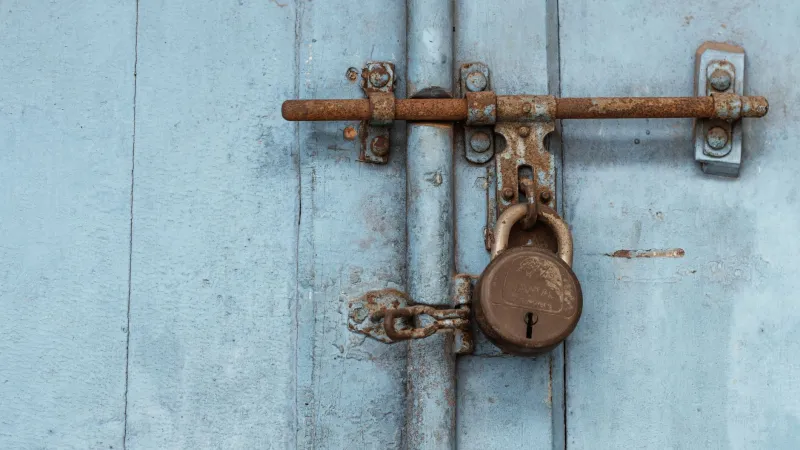
Fort Knox with Rust
This gate has a chain, a padlock, a second padlock as backup, and a bolt that could withstand a siege. It is attached to a fence that is otherwise held up by hope. The message is clear: the marrows are protected, the raspberries are not to be sampled, and the owner has a system.
The code is never written down. It is passed verbally, like a family recipe, usually with the phrase “don’t share it, because Gary.” Nobody knows exactly what Gary did, but the padlock remembers.
The Welcoming Latch and Kettle Sign
Here the gate opens with a gentle click and a sign that says “COME IN — KETTLE’S ON” in letters that have been lovingly repainted. There may be a small tin for donations to the hedge fund, a hook for a spare carrier bag, and a handwritten note inviting you to take some surplus courgettes. This is the diplomatic wing of the allotment movement.
Do not mistake friendliness for carelessness. The latch is welcoming; the sign about not pinching the rhubarb is not.
The Ghost Gate
A frame with no gate, or a gate with no fence, or a gate that opens onto a patch of nettles and a distant shed. This is less an entrance than a rumour. It suggests a plot-holder who has moved, died, been defeated by bindweed, or simply discovered golf. The gate remains, doing its best, guarding nothing but the idea of order.
Padlocks, Codes and Quiet Politics
The allotment gate code is one of Britain’s strangest social contracts. It is not a password in the dramatic sense. It is more likely four digits daubed inside a shed, whispered at the water butt, or sent by text with the caveat “it’s the same as the old one but backwards.”
Who gets the code is a delicate matter. New plot-holders arrive with enthusiasm and a sturdy padlock. The committee arrives with a clipboard and a reminder that the main gate code was changed after the incident with the communal strimmer. Nobody will explain the incident. Everybody knows it involved Trevor.
There is politics in a gate chain. The person who holds the spare key becomes a minor deity of access. The person who forgets to relock the gate becomes a topic at the next committee meeting. And the person who installs a personal padlock on a shared gate? That person has declared war, or at least a prolonged period of passive-aggressive signage.
How to Read a Gate Before You Lean Over It
A light-hearted checklist for the allotment-curious:
- Check the latch height. A low latch means “come in.” A high latch means “come in, but not with a dog.”
- Read the signs. “Please shut the gate” is standard. “Please shut the gate — the hens are idiots” is a cry for help.
- Look at the padlock. A shiny new padlock suggests recent betrayal. A rusty one suggests tradition.
- Respect the twine. If the gate is tied shut with baler twine, the twine is the lock. Do not untie it unless invited.
- Listen for the kettle. If you hear a kettle, proceed with cheerful caution. If you hear a committee, retreat to the car park.
And if someone gives you the code, treat it like a library card: useful, personal, and not to be passed to Gary.
The allotment gate is a small, squeaky masterpiece of British DIY. It keeps out rabbits, slows down strangers and quietly records the plot-edge politics of a whole community. Next time you push one open, give it a moment. Somewhere between the flaking paint and the fourth padlock, there is a whole life story — and probably a warning about the rhubarb.